Early Dynastic Egypt
Upper and Lower Egypt become joined under a royal court and expanding written administration.
Nile Valley, c. 3100-30 BCE
Kemet
A river civilization whose farms, towns, temples and state institutions repeatedly reorganized across three millennia.
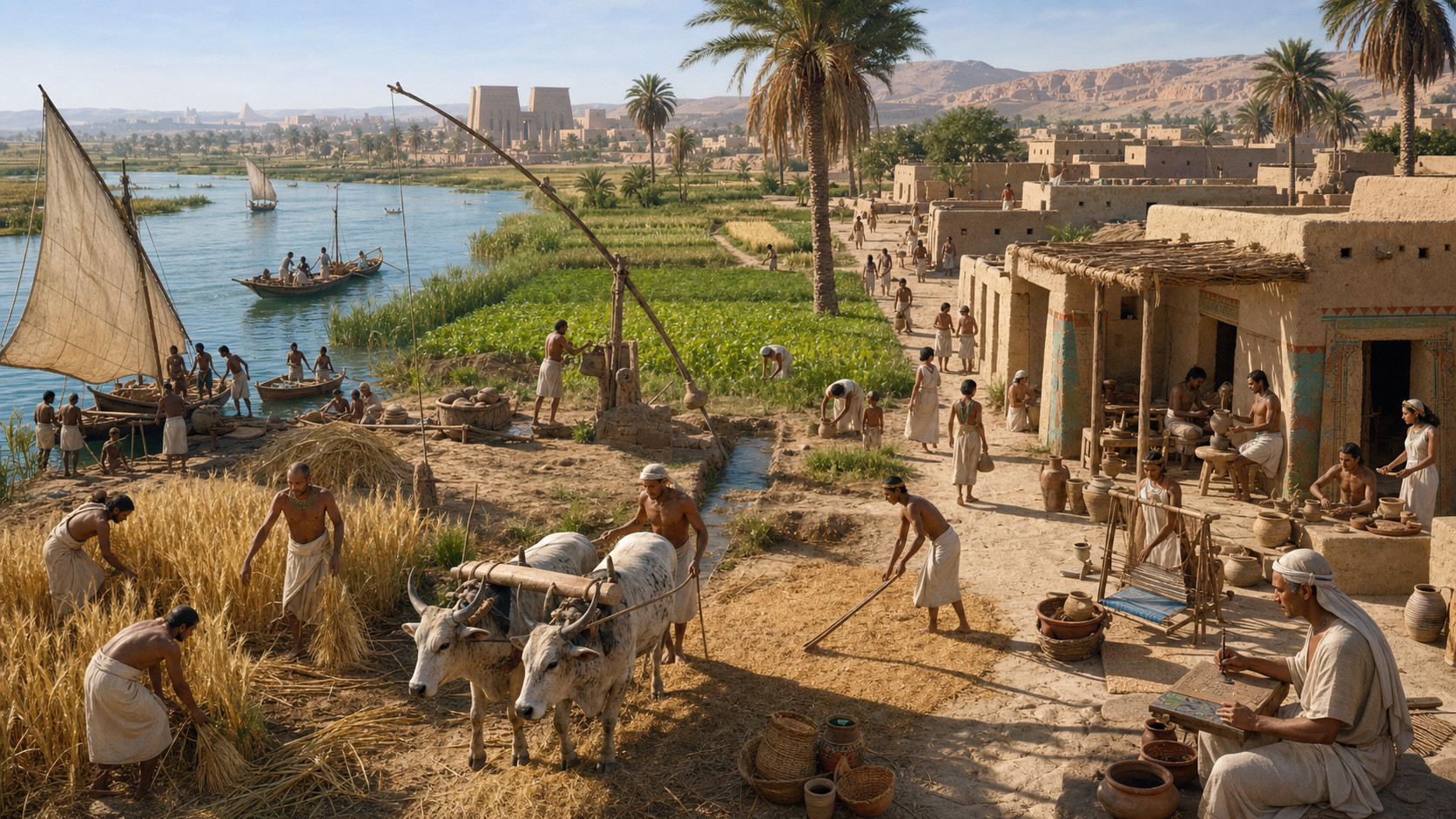
Begin with an ordinary dayOriginal interpretive reconstruction. Details synthesize archaeological evidence; it is not a photograph.
Core geography
The Nile Valley and Delta between river, desert and MediterraneanPolitical ideal
A divine kingship responsible for order, temples, defense and redistributionEconomic base
Floodplain grain, livestock, linen, river transport, craft estates and taxationEvidence
Settlements, tombs, temples, papyri, tools, human remains and environmental dataLong view
Dates are approximate and regional. The purpose is to prevent objects and practices from different centuries being shown as one timeless culture.
Upper and Lower Egypt become joined under a royal court and expanding written administration.
Royal pyramid complexes, large institutions and provincial elites shape the state.
Political reunification, irrigation projects, literature and long-distance expeditions flourish.
A territorial empire supports major temples, international exchange and densely documented communities.
Egyptian institutions continue under changing dynasties, Persian rule and a Macedonian royal house.
Lived time
A composite day reveals recurring work, movement and ritual while keeping status and regional differences visible.
Households ground grain, mixed dough and organized water. Bread and beer were daily staples made in many forms and strengths.
Farmers irrigated, plowed, sowed or harvested according to the agricultural cycle. Fishers, boat crews and herders worked the river edge.
Potters, weavers, carpenters, stoneworkers and metalworkers labored for households, estates or institutions. Scribes tracked deliveries and rations.
Courtyards supported cooking, textile work, repair, storage and childcare. Flat roofs could provide additional sleeping or work space.
Families ate bread, vegetables, pulses, onions, dates, fish and, depending on means, meat. Music, stories and board games offered leisure.
Ordinary people normally remained outside inner sanctuaries, but processional festivals carried a divine shrine into courts and streets.
Home & body
Daily life was produced through food, water, housing, clothing, kinship and unequal access to labor and resources.
The river watered fields, moved stone and grain, carried officials and joined settlements. Agricultural work followed inundation, emergence and harvest cycles, though timing and control changed over time.
Sun-dried mudbrick formed towns, houses, walls and storage magazines. Stone was concentrated in temples, tombs and selected royal works, which biases what survives.
Plans varied by wealth and place, but central rooms, courtyards, roofs, storage and food-preparation areas made houses flexible working environments.
Flax supplied garments from simple kilts and dresses to finely pleated elite clothing. Jewelry, wigs, cosmetics and scent marked care, protection and status.
Marriage and inheritance were social and legal arrangements rather than temple sacraments. Women could own, inherit and transfer property, although offices and wealth remained unequal.
Tombs, offerings and funerary texts aimed to sustain a transformed existence. This focus reflects an intense attachment to life, family, food, landscape and memory.
Production & exchange
The spectacular monument depended on ordinary systems of land, skill, transport, accounting and coerced or dependent labor.
Cultivators grew emmer wheat, barley, flax, vegetables and fruit; tended cattle, sheep, goats and poultry; and delivered produce to landholding institutions.
Organized crews quarried, transported and set stone, made bricks and maintained canals. Skilled workers and rotating labor obligations existed alongside coerced labor.
Temple, palace and private workshops produced linen, faience, glass, furniture, metalwork, sculpture and decorated tomb equipment.
Writing enabled land surveys, rations, legal documents, taxes, correspondence and ritual knowledge. Literacy was specialized, not universal.
Sails, oars and current moved people and bulk goods more efficiently than roads. Harbors and quays linked farms to royal and temple magazines.
Egypt acquired cedar, incense, metals, stone, ivory and luxury goods through diplomacy, trade, tribute and state expeditions.
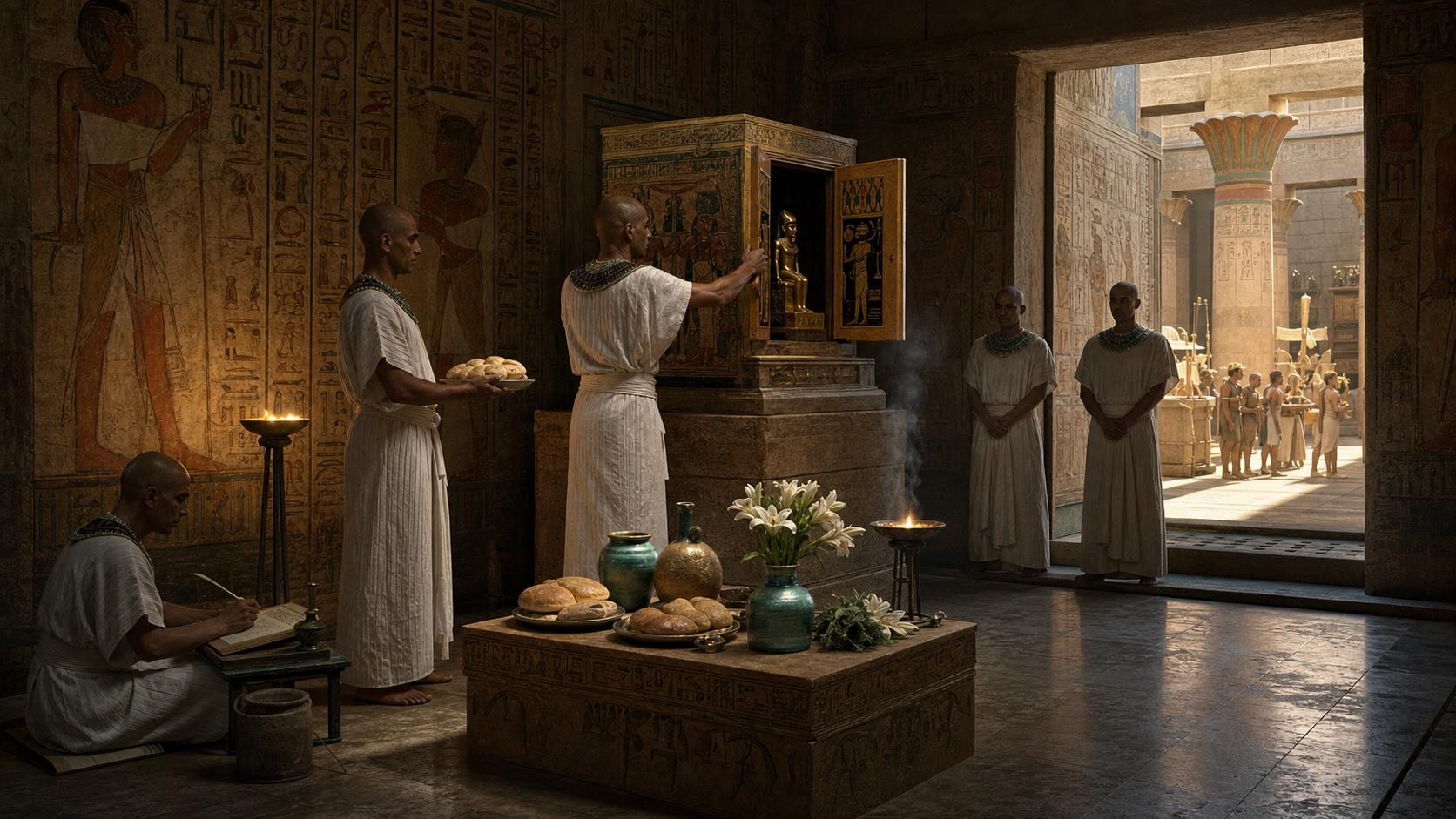
Original interpretive reconstruction. Ritual access and actions are simplified for one readable scene.
Ritual practice
Egyptian temples were residences for deities and engines for maintaining maat: right order, balance and continuity. Monumental scenes show the king serving the gods, but trained priests usually performed the daily work.
A serving priest washed, changed into clean linen and entered restricted spaces under rules of bodily purity.
At dawn the sealed sanctuary was opened and the cult image made accessible for service.
The image could be censed, washed, anointed, clothed and presented with insignia.
Bread, beer, meat, fruit, flowers, incense and ointment were placed before the deity. After ritual use, food could circulate among temple personnel.
The image was returned, doors closed and traces of entry ritually removed.
On festivals, the deity's portable shrine traveled beyond the sanctuary, making divine presence publicly visible and enabling oracular encounters.
Sacred figures and powers
A major New Kingdom state deity combining hidden power and solar creation.
Ruler of the transformed dead and model of regeneration.
Divine mother, protector and powerful ritual agent whose worship later spread widely.
Linked to music, joy, sexuality, motherhood, foreign lands and the welcoming of the dead.
Creator and patron strongly associated with craftspeople at Memphis.
Bes, Taweret and ancestors addressed childbirth, health, danger and domestic well-being.
Power & belonging
Status came from overlapping legal, political, household, occupational, gendered and dependent relationships.
The pharaoh and court embodied state authority, diplomacy, military command and the ideal maintenance of maat.
Officeholders managed land, labor, archives and cult. Careers could be hereditary, trained or won through patronage.
Some workers lived in state-supported communities such as Deir el-Medina, receiving rations and leaving unusually rich records.
Most people produced food and owed rents, goods or service. Their voices survive less often than elite images of their work.
Captives, servants and enslaved individuals existed, but legal statuses varied; the population cannot be reduced to a pyramid-building slave stereotype.
Material lives
Objects connect technique to routine: each one belongs to a chain of material sourcing, skilled labor and social use.
Counterweighted device used to lift water into channels, especially well attested from the New Kingdom onward.
Wooden or stone palette with ink wells and space for reed pens.
Wooden handle fitted with flint blades, later complemented by metal forms, for cutting grain.
Horizontal and vertical looms turned flax thread into linen for households, institutions and exchange.
Grid game associated with recreation and, over time, symbolic passage through the afterlife.
Stone or ceramic surface receiving food and drink for gods or the dead.
Named lives
A name survives because a document, monument or later tradition preserved it. Famous rulers are placed beside poets, workers and officials where evidence allows.
Third Dynasty king whose Saqqara complex marks a decisive experiment in monumental stone construction.
Eighteenth Dynasty pharaoh who ruled as king and sponsored building, trade expeditions and divine claims.
Architect, administrator and learned official under Amenhotep III, later revered for wisdom and healing.
King who elevated the Aten and built a new city at Akhetaten; his program was exceptional and short-lived.
Principal wife of Ramesses II, represented in monumental and funerary contexts with high status.
A documented workman at Deir el-Medina whose contentious career reveals law, labor and neighborhood life beyond royalty.
Atlas
Each site offers a different scale of evidence: house, port, sanctuary, capital, cemetery or workshop settlement.
A long-lived administrative capital zone and cemetery with royal, elite and sacred monuments.
New Kingdom royal and temple landscape spanning Karnak, Luxor and western-bank cemeteries.
Planned village of royal tomb workers with houses, ostraca, legal disputes and household shrines.
Akhenaten's purpose-built capital, invaluable for excavated houses, workshops, temples and archives.
Cult center of Osiris and place of pilgrimage, royal memory and long ritual continuity.
Ptolemaic capital and Mediterranean metropolis where Egyptian and Greek institutions interacted.
Source ledger
Museum, university, archaeology-department and UNESCO resources are used as starting points. Follow the links for object records, excavation reports and deeper bibliographies.
A museum publication on houses, gardens, food, furnishings, family life and work.
The Metropolitan Museum of ArtMaterial evidence for how the Nile shaped food production, work and settlement.
The British MuseumTemple offerings, cult images and the logic of the daily service.
UCL Digital EgyptTemples as divine residences and settings for rituals normally performed by priests.
The Metropolitan Museum of ArtArchaeological plans for courtyard, three-room and tripartite houses.
UCL Digital EgyptKingship, pyramid complexes, elite tombs and scenes of agricultural and craft work.
The Metropolitan Museum of ArtVisual reconstructions were generated for this site from detailed historical prompts. They are labeled as interpretations and are never used as evidence for a claim. Source links support the written account.